Titanium — the standard implant material
Implant-supported teeth feel and look like natural teeth.
The long-term success of implant therapy is determined by various factors. Alongside the patient's individual situation – the bone available and the density of the implant site – the implant material, the implant design and the implant surface all play an important part.
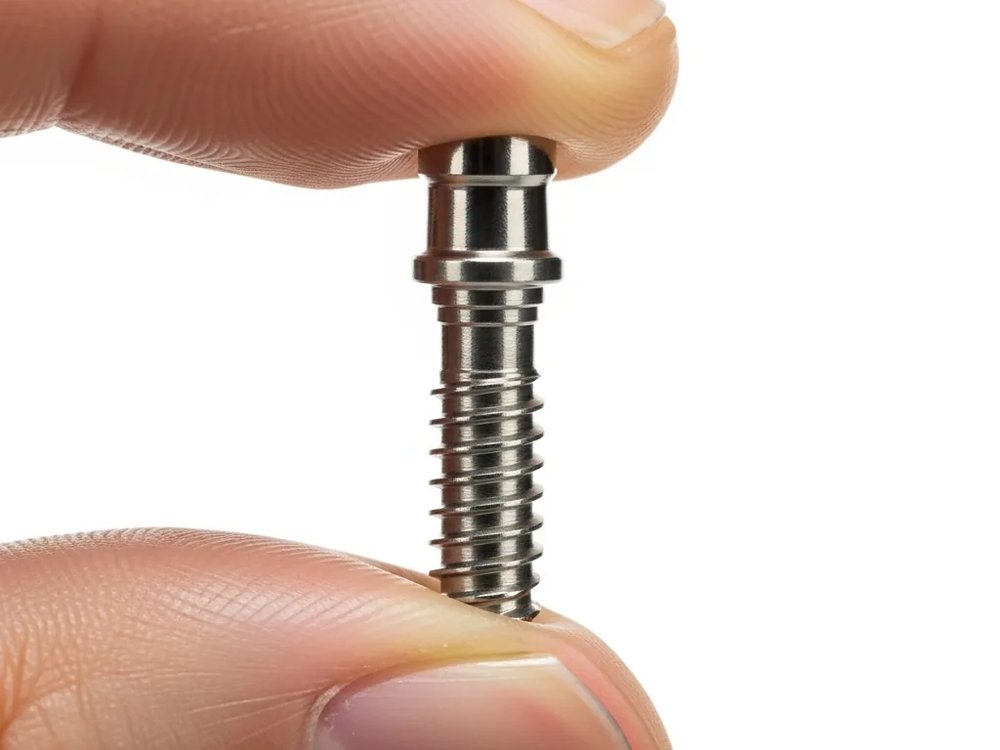
Material
Titanium is today the standard in implantology
Innovative high-performance materials point the way ahead: Roxolid®, an alloy of titanium and zirconium, is markedly stronger, for example.
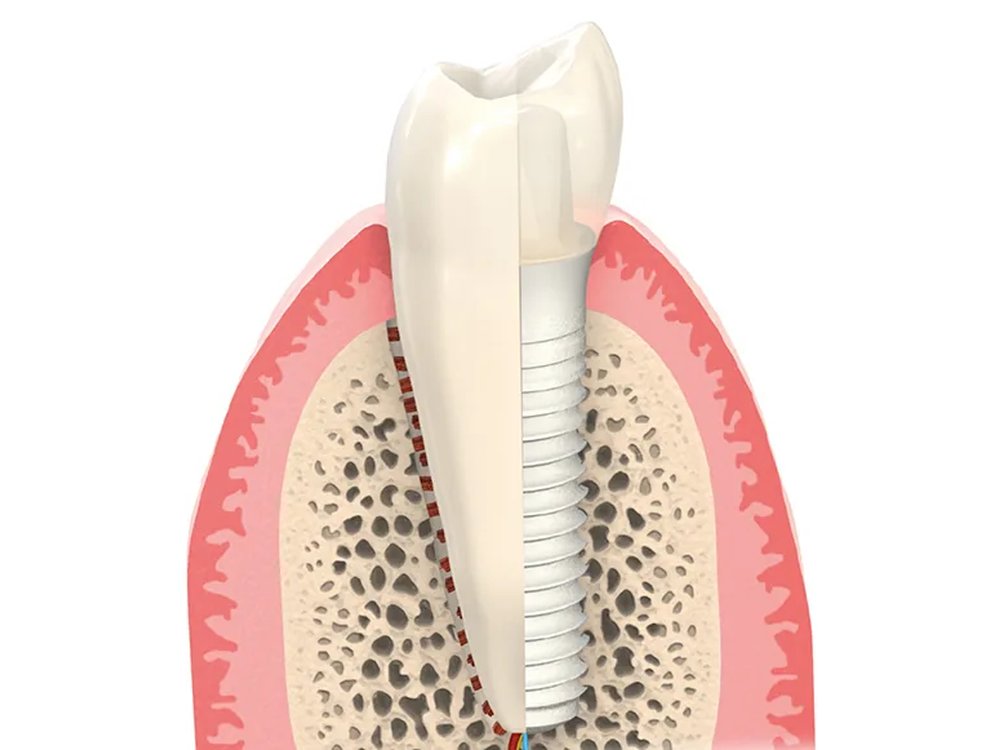
Metal-free
Tooth-coloured ceramic implants
For patients with immunological sensitivities, ceramic implants of high-performance zirconium dioxide (Y-TZP) are now available.
In every implant the body of the implant replaces the original tooth root. In endosseous implants, anchored in the bone, the body is mostly cylindrical and is anchored directly in the jawbone by a thread. Once healed, the implant forms the foundation for the new teeth, the superstructure. Like a real tooth root, an endosseous implant sits firmly in the jawbone after osseointegration.
Implant-supported teeth feel and look natural and are hard to tell apart from natural teeth. Crowns can be attached to the implants; where several teeth are missing, bridges; and where there are no teeth at all, removable or firmly anchored full dentures.
Looking back
The history of implants
The idea of oral implantology has a long history. Centuries before Christ, the Etruscans and Egyptians were already trying to replace lost teeth with bone carved into the shape of teeth, or with animal teeth. These first restorations were attached to the neighbouring teeth with gold wire.
The real breakthrough came only in the twentieth century. The fundamental scientific work on developing a dental implant was carried out in the 1950s and 1960s by two professors. Their discovery that the human body not only tolerates titanium but actually bonds with it through living bone tissue revolutionised dental implantology. Their findings on long-term stability contributed decisively to the success and further development of dental implants.
Pioneers of modern implantology
The foundations of today's dental implantology were laid in Sweden by Professor Per-Ingvar Brånemark and in Switzerland by Professor Reinhard Straumann. They are regarded as the pioneers of modern implantology; they revolutionised dentistry and paved the way for the field.
Their implants are still used today in modified form and are among the best scientifically documented implant systems. International, scientifically sound findings and decades of experience with titanium implants are available. Implantology has become one of the best documented treatments in the world.
The Swedish Professor Per-Ingvar Brånemark discovered in 1952 at the University of Lund that titanium and human bone can form a firm bond. He placed the first implants in 1965 and named the process by which bone attaches to the implant osseointegration.
As a metallurgist, Professor Reinhard Straumann created the scientific foundations for incorporating metals into bone. He developed titanium dental implants whose healing Professor André Schroeder of the University of Bern was among the first scientists to investigate. Straumann introduced the world's first one-stage hollow-cylinder implants in 1974, followed in 1976 by a screw-shaped implant of pure titanium.
One-piece implants
One-piece implants, which heal transgingivally, consist of a single component: the intraosseous and the prosthetic parts are integrated into one unit. The depth at which the implant is placed is defined by the prosthetic plane. After placement the implant projects above the mucosa, so the exposure operation when the restoration is fitted is not needed.
Two-piece implants
The development of two-piece implants and of closed, subgingival healing beneath the mucosa was advanced by Professor Brånemark. He divided the implant structure into an intraosseous part, the implant, and a prosthetic part, the abutment. The implant is placed at bone level and covered by the mucosa, which is intended to ensure reliable osseointegration: beneath the mucosa the implant heals free of mechanical loading and bacterial colonisation. After healing the implant is exposed and then restored with an abutment and the new tooth.
Round screw implants – rotationally symmetrical implants – have prevailed in implantology. There are now a great many implant designs, differing above all in their conical shape, surface treatment, material and type of thread. Screw-shaped implants with their special threads allow an implant to be anchored in the bone with the necessary primary stability.
The key points at a glance
- Titanium is today the standard in implantology; the body accepts it like its own tissue.
- For patients with immunological sensitivities there are ceramic implants of zirconium dioxide (Y-TZP).
- Besides the material, implant design and surface determine long-term success.
- The breakthrough came in the 1950s and 1960s through Per-Ingvar Brånemark in Sweden and Reinhard Straumann in Switzerland.
Answered briefly