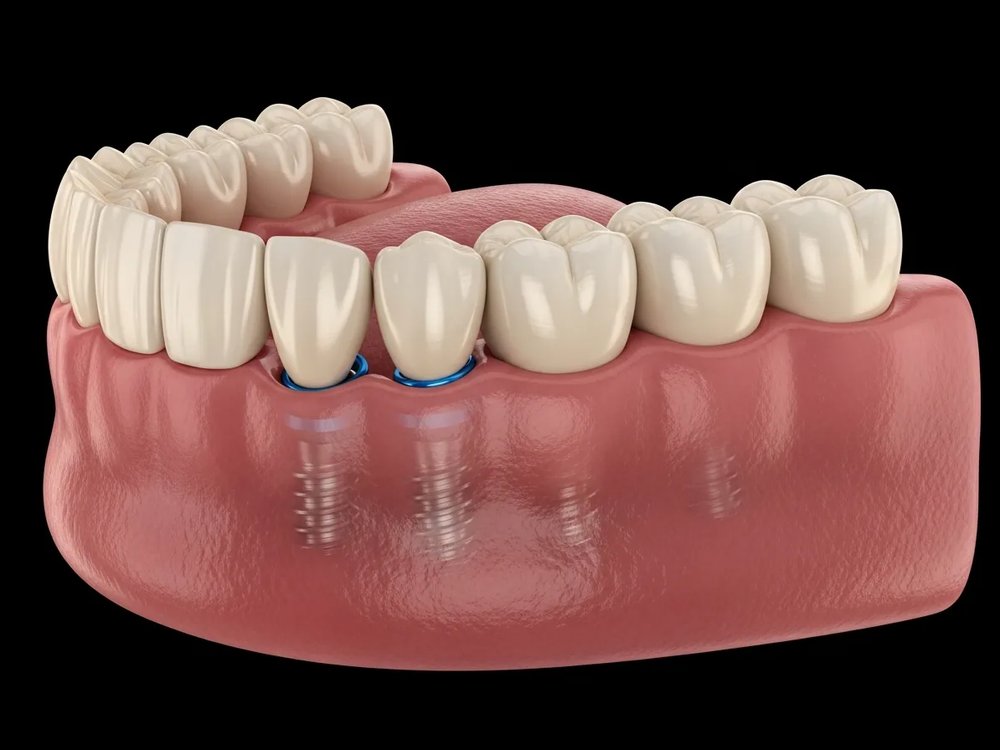
The edentulous jaw with four tilted implants
A complete prosthetic restoration can be secured on four implants per jaw.
4 to 6 angled implants


Immediate fixed restorations for edentulous patients
Individual planning matters particularly with an immediate restoration. The bone available, its volume and its quality are determined on the basis of three-dimensional cone beam computed tomography. Special planning software establishes the position of the implants, and a surgical guide is produced from the 3D data. This guide ensures gentle placement and precise positioning. The concept is an alternative to conventional implant treatment and is ideal for patients who want to avoid lengthy bone grafting and the longer healing period that goes with it. The approach allows prosthetic flexibility, permitting bar-supported or screw-retained dentures. Because fewer implants are placed, the cost of the implant-supported solution is affected too.
Directly after placement a provisional but already firmly seated restoration can be fitted. Patients can generally load it normally shortly after it is fitted. After a healing period determined individually, lasting a few weeks or a few months, the definitive restoration can be placed.
An implant-supported restoration on just four implants is designed exactly as a conventional implant solution would be. The denture looks like natural teeth; its shape and colour cannot be told apart from them.
Solution
Four implants for an edentulous jaw
With a new generation of surgical and prosthetic components, a complete prosthetic restoration can be secured on four implants per jaw. This solution takes account of the individual anatomy of edentulous patients with bone atrophy. It is a less complex way of treating jaws without teeth using a fixed, implant-supported restoration, and it is a very good option for patients who, because of long-standing edentulism and the bone loss that comes with it, are not candidates for conventional implantology. The concept can offer solutions with considerably shorter procedures.
In this variant – the edentulous jaw with four tilted implants – the implants are placed at particular angles so that the load is well distributed and the new teeth sit firmly. Two implants are placed at the front and two at the back of the arch. Tilting the posterior implants makes optimum use of the bone available. The tilted implants spare sensitive structures such as the maxillary sinus and the nerves and achieve a stable hold in the bone of the jaw base: in the lower jaw the nerve is spared, in the upper jaw the sinuses. Implants placed at an angle can absorb greater chewing loads. A solution on just four implants gives the restoration a stable foundation, providing the stability needed for chewing and a secure hold for speaking. With conventionally placed implants that stability could only be achieved with a larger number.
Where appropriate, the implants can be placed in a minimally invasive, tissue-preserving way without cutting the gum open. In that case less pain or discomfort is to be expected afterwards. The operation can be gentler and the overall treatment time shorter. Since only four implants have to be placed in the upper jaw instead of six, the surgical effort is also reduced. Discomfort and pain for the patient should be kept to a minimum, and a long, elaborate course of treatment to rebuild lost bone can often be avoided.
The key points at a glance
- A complete restoration of an edentulous jaw can be secured on four implants.
- The posterior implants are placed at an angle and so make better use of the bone available.
- Placing them at an angle spares the maxillary sinus and the nerves and allows greater stability.
- Planning is based on a three-dimensional scan; a surgical guide transfers the plan into the mouth.
Answered briefly