Implant-supported dentures on bar constructions
Removable implant-supported dentures do not slip and prevent pressure sores.
Restorations on bars
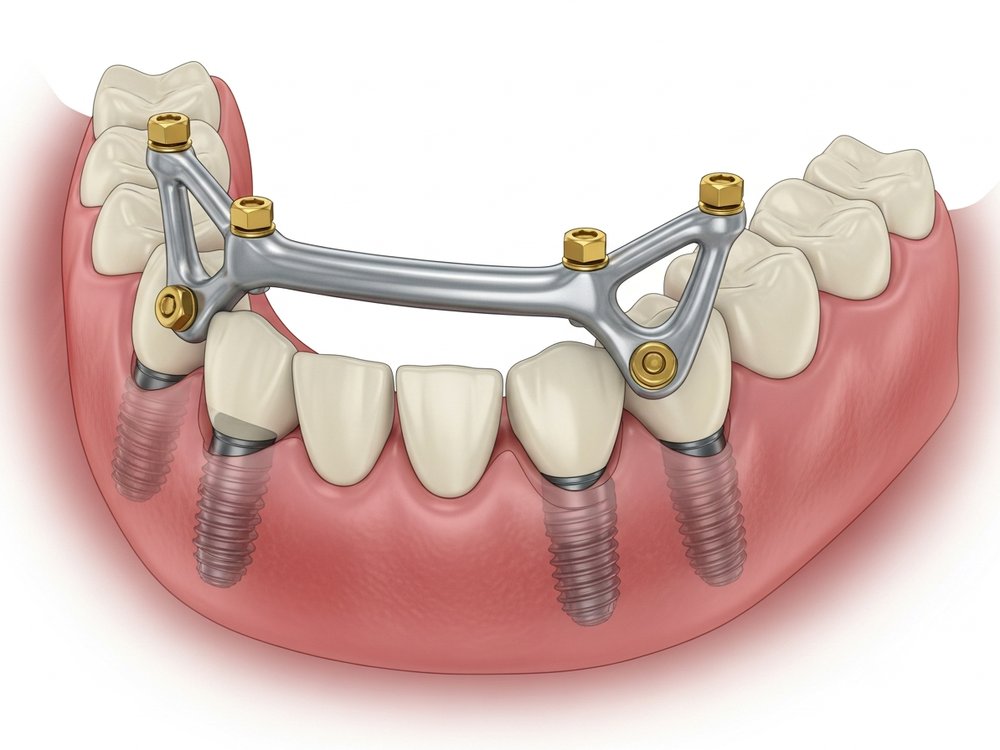
Removable implant-supported restorations on bars are suitable for the edentulous upper and lower jaw. Where the anatomy is favourable, implants splinted by a bar can be loaded immediately after splinting. The bar construction is screwed firmly to the implants. This splinting prevents movement of the implant that would endanger healing and osseointegration. Long waiting times during healing, and the temporary restorations that go with them over several months, can be avoided. A bar construction can allow patients to be restored within a short time. The principle holds, however, that four implants are needed if they are to be loaded with a denture immediately after placement and splinting.
A removable implant-supported denture attached to these bars with clips does not slip and protects against pressure sores. Pain while chewing becomes a thing of the past. The bar construction promises great stability. The dentures sit firmly on their abutments, the implants, and can be designed to leave the palate free, so that the sense of taste is not impaired by denture material. This form of attachment spares patients the drawbacks of classic dentures. The denture is taken out of the mouth for cleaning, which makes a removable bar-supported implant solution particularly comfortable for older patients: it can be removed easily for cleaning and care even where dexterity is limited. If the restoration is damaged it is relatively simple and inexpensive to repair. Patients keep their natural sense of taste, because no artificial denture material is used in the palate for the upper jaw solution. For patients with an edentulous jaw, the bar-supported denture is a good alternative to a mucosa-borne restoration.
The bar construction provides full chewing function with a high degree of comfort and allows aesthetically demanding solutions. It has been proven over many years, and its components have been improved continuously.
Bars are often made of gold and have an oval shape (the Dolder bar). Retaining elements or clips are worked into the base of the denture and slide over the bar. Bars can be prefabricated, cast or milled.
If the implants are to be loaded while they are still healing and not yet osseointegrated, at least four implants are recommended for the bar construction. Primary splinting of the implants by the bar is indispensable in that situation. The dentist decides how many implants are needed according to the patient's individual anatomy and the planned prosthetic restoration.
Solution
A secure hold with a bar
Bar constructions are a good and proven way of securing a full denture on implants. Anchoring a full denture on implants joined to one another by bars is an established and well-documented form of implant-supported restoration. The denture finds its hold on a metal bar connecting the implants. Two or more implants are joined by individually made or prefabricated metal bars, produced to suit each patient's situation. This tension-free splinting supports an even loading of the individual implants. Bar connections can be made in simple and in complex variants.
The key points at a glance
- A full denture can be attached to a metal bar connecting two or more implants.
- Splinting by the bar prevents movement of the implants that would endanger healing.
- The solution suits the edentulous upper and lower jaw and is regarded as well documented.
- Where the anatomy is favourable, the splinted implants can be loaded immediately after they are connected.
Answered briefly