Alternatives to implant-supported restorations
Besides implants, the classic ways of securing new teeth in the jaw are bridges and partial or full dentures.
Besides implant-supported restorations, the classic ways of securing new teeth in the jaw are fixed prosthetics (a bridge), removable prosthetics (a partial or full denture), or a combination of the two.
Where the gap is small, a bridge is usually used. Larger gaps and so-called free-end situations – where the molars are missing, for example – are restored and closed with dentures.
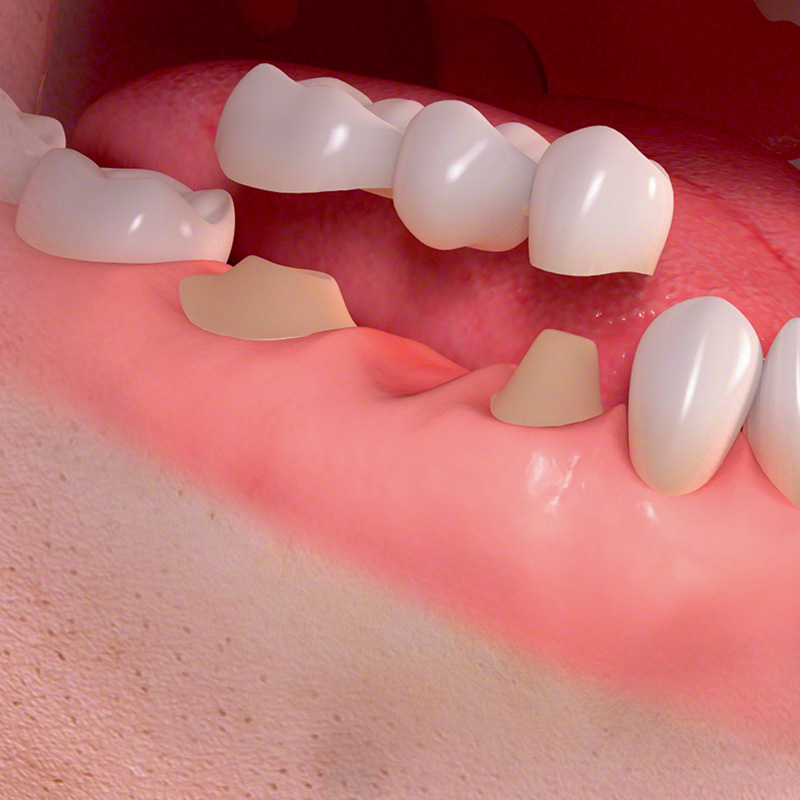
Fixed restorations: bridges
When several teeth are lost, appearance and chewing function often suffer considerably. The teeth no longer stabilise one another. Such gaps have to be closed with a bridge to prevent incorrect loading. Bridges secure chewing function and make it possible to restore a complete row of teeth.
To attach a bridge, the neighbouring teeth have to be ground down. The bridge construction is then anchored or bonded onto these abutments.
Advantages and disadvantages of a bridge
Advantages:
- The new teeth are firmly anchored.
- No surgery is involved.
Disadvantages:
- Because the neighbouring teeth, usually vital ones, are ground down, healthy tooth substance is destroyed for good.
- There is a risk that grinding damages them so severely that they die.
- Grinding, and excessive chewing loads on the neighbouring teeth serving as abutments, can lead to their early loss.
- Caries can form at the margin of the bridge.
- The bone is not loaded, which can lead to bone loss. Thanks to dental implantology, grinding down healthy teeth for a bridge is no longer necessary.
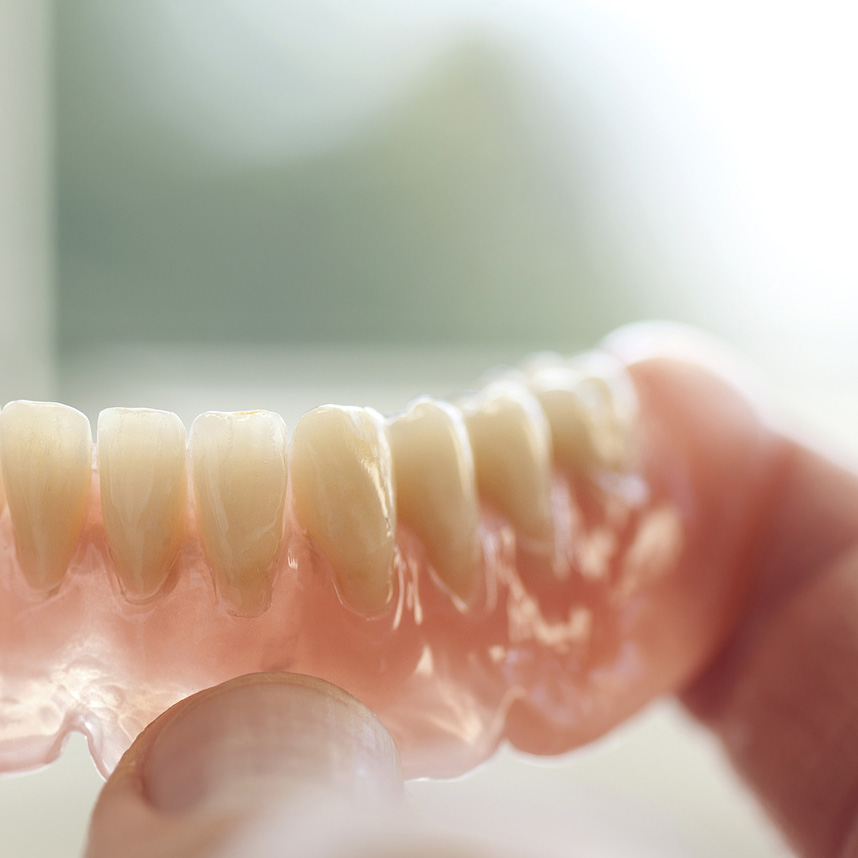
Removable restorations: conventional dentures
Classic dentures come in two forms: partial and full.
Partial denture
A larger gap can be closed with a partial denture. The new teeth are attached to the remaining ones by clasps. This is an inexpensive option, but it does not deliver demanding aesthetics. A further drawback: the remaining teeth can be loosened by the unfavourable loading. That can lead to tooth loss and so to an even larger gap.
Full denture
A full denture gives edentulous patients a complete set of teeth again. Here the new teeth are carried by a gum-coloured acrylic base. In the upper jaw this covers the whole palate, which can impair the sense of taste. The denture is held in place by suction. Sticky saliva and a pronounced alveolar ridge help a full denture to hold better.
Advantages and disadvantages of classic dentures
Advantages
- An inexpensive option
- No surgery required
Disadvantages
- A full denture impairs the sense of taste
- Chewing function is limited
- An insufficient hold can lead to painful pressure sores
- Dentures can affect speech
- The restoration is not firmly anchored
- Results are sometimes not satisfying aesthetically
- A psychological burden for the patient, since self-esteem and quality of life can suffer
- Damage to the remaining teeth when a partial denture is worn
- Bone loss can occur, because the bone is not loaded.