What is a dental implant? An implant is an artificial tooth root
Dental implants are artificial tooth roots made of pure titanium, a material the body accepts like its own tissue.
The basics
The artificial tooth root
A dental implant is an artificial tooth root made of pure or high-purity titanium; more recently zirconium dioxide has also been used in ceramic implants. Both materials are accepted like the body's own tissue and are notable for their excellent biocompatibility and tissue tolerance. No allergic reactions are known. Sound worldwide knowledge and experience of titanium dental implants in dentistry go back more than forty years.
Dental implants replace one tooth or several. The implant takes over the job of the tooth root. Placed in the jawbone, it transfers chewing forces into the bone after healing, just as a natural tooth does.
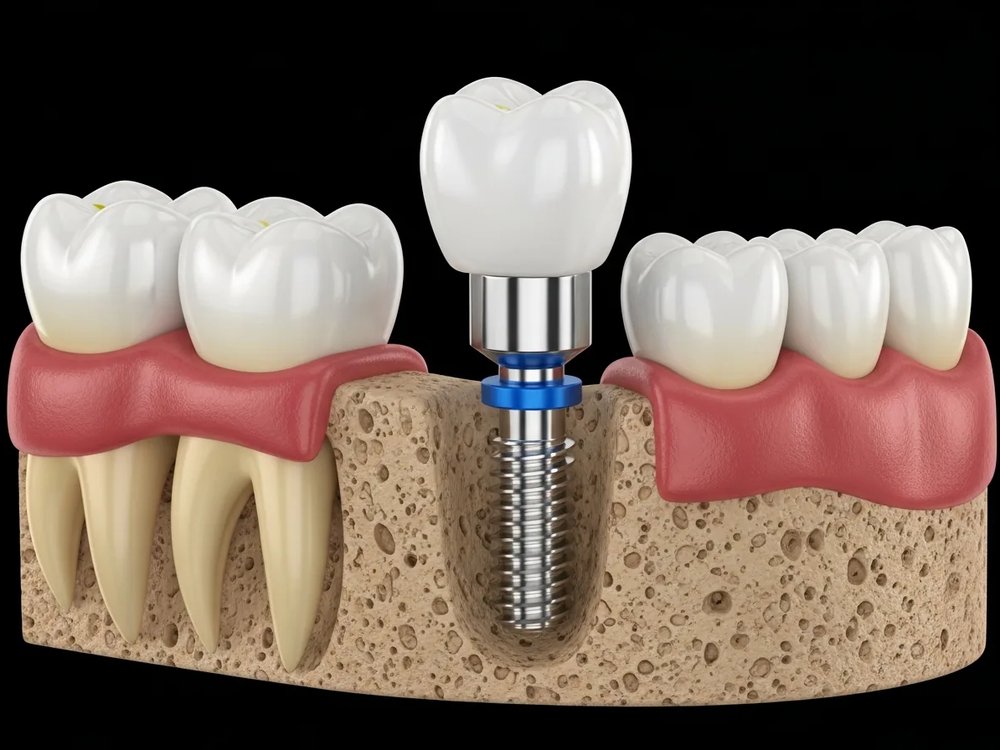
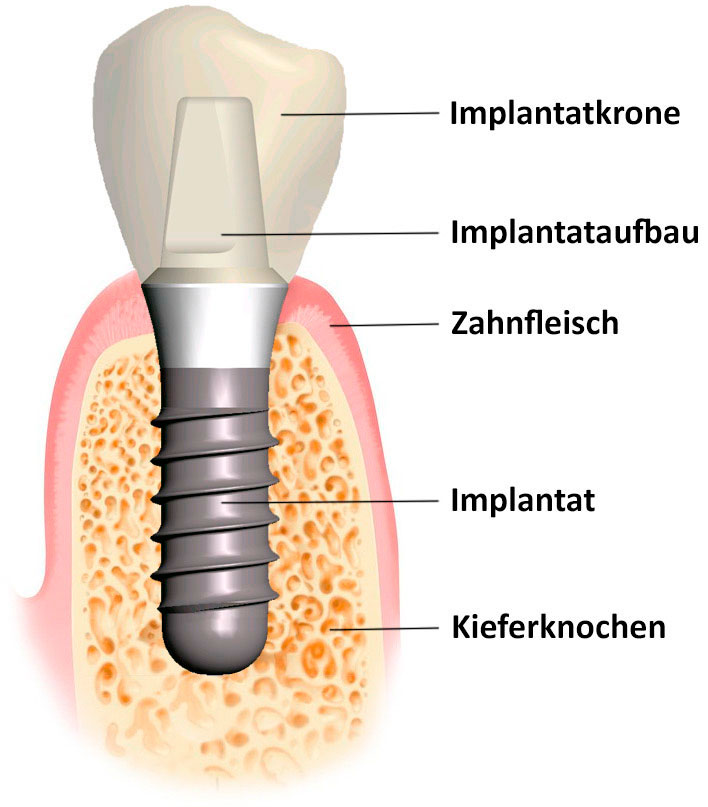
A dental implant consists of several components: the implant itself, the abutment and the implant crown. Implants are usually placed in the upper or lower jaw as an outpatient procedure under local anaesthetic or sedation (twilight sleep). If the patient wishes, the procedure can also be carried out under general anaesthesia.
The implant is placed in the jawbone and fuses firmly with it during a healing period of several months. This process is called osseointegration. Once healed, the implant forms a secure foundation for the restoration it is to carry – crowns, bridges or dentures. When the bone tissue has fused firmly with the implant, the restoration, also called the superstructure, is attached to this stable base.
Dental implants are in most cases shaped like a cylindrical or conical screw (details under implant shape). The material, surface, length and diameter of an implant vary with its intended use and the patient's clinical situation. Length and diameter are chosen to match the bone volume and quality. Three-dimensional diagnostics provide exact information about the bone available and help in selecting a suitable implant design. The thread of the implant provides mechanical stability once it is placed – primary stability – which is the precondition for the implant to heal.
One-stage and two-stage dental implants
A one-stage implant projects above the mucosa after placement and heals transgingivally.
The two-stage implant is placed at bone level in a subgingival procedure. The mucosa is opened over the bone with a small incision and the bone exposed. Special drills create the implant site. Once the implant has been placed, the mucosa is closed again. After healing, the implant is exposed in a small surgical procedure and an abutment is screwed onto it. The abutment bridges the distance between bone level and the gum margin, and carries the implant crown.
The structure joined to the implant – the crown or bridge, also called the superstructure – usually consists of a metal framework onto which the dental technician builds the new teeth. For aesthetically demanding solutions, metal-free all-ceramic superstructures are made. Modern CAD/CAM technology allows individualised reconstructions: single teeth, bridges and whole arches can be produced from high-strength zirconium.
Implant-supported dentures, arches, bridges and single teeth sit firmly. Patients are spared the drawbacks of a classic denture (poor fit, pain when chewing, a limited sense of taste and uncertainty when speaking) and of attaching a restoration with retaining clasps (long-term damage to the remaining teeth).
Titanium (titanium implants) is today regarded as the standard in implantology. Innovative high-performance materials point the way ahead: Roxolid® (Roxolid® implants), an alloy of titanium and zirconium, is markedly stronger, for example. For patients with immunological sensitivities, ceramic implants of high-performance zirconium dioxide (ceramic implants) are now available.
What is a dental implant? It is a solution that offers the possibility of a secure, firmly seated restoration in almost any situation.
The key points at a glance
- A dental implant consists of three parts: the implant body in the bone, the abutment and the visible crown.
- The implant body is made of pure titanium or of zirconium dioxide. Both materials are accepted like the body's own tissue.
- Worldwide experience with titanium implants goes back more than forty years; no allergic reactions are known.
- With a one-stage implant the head projects through the gum while it heals; a two-stage implant heals beneath it.
Answered briefly